


Families Stick Together
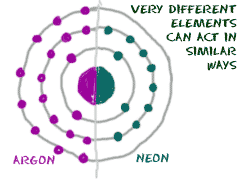 We just covered the columns and rows of the periodic table. There are also other, less specific, groups of elements. These groups are all over the table. Scientists group these families of elements by their chemical properties. Each family reacts in a different way with the outside world. Metals behave differently than gases, and there are even different types of metals. Some elements don't react, while others are very reactive, and some are good conductors of electricity.
The columns of the periodic table are often used to define families. The noble gases are all located in the far right column of the table. That column is labeled Group Zero. Other families can be made of elements in a series. A good example of a series of elements is the transition metal family.
The thing to remember is that a family of elements can be found in several ways. You need to run tests and study the elements to determine their properties. Only after that testing can you determine what family an element belongs in.
Examples of Families
- Alkali Metals- Alkaline Earth Metals
- Transition Metals
- Halogen Gases
- Noble Gases
Examples of Physical Properties
- Density- Boiling Point
- Melting Point
- Conductivity
- Heat Capacity
Examples of Chemical Properties
- Valence- Reactivity
- Radioactivity
Related Video...
Exploring Ozone (NASA Video)
- Overview
- Periodic Table
- Element List
- Families
- Halogens
- Noble Gases
- Metals
- Alkali Metals
- Alkaline Earth
- Transition Metals
- Lanthanide
- Actinide

 See the full list of chemistry topics at the site map!
©copyright 1997-2018 Andrew Rader Studios, All rights reserved.
Current Page: Chem4Kids.com | Elements & Periodic Table | Element Families
** Andrew Rader Studios does not monitor or review the content available at external web sites. They are paid advertisements and neither partners nor recommended web sites. Also, we do not collect or ask for personally identifiable information on any of our sites. Privacy Policy/Terms & Conditions