

Catalysts Speed It Up
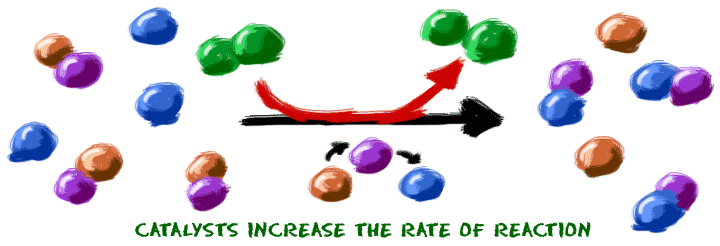
A catalyst is like adding a bit of magic to a chemical reaction. Reactions need a certain amount of energy in order to happen. If they don't have it, oh well, the reaction probably can't happen. A catalyst lowers the amount of energy needed so that a reaction can happen more easily. A catalyst is all about energy. If you fill a room with hydrogen gas (H2) and oxygen gas (O2), very little will happen. If you light a match in that room (or just produce a spark), most of the hydrogen and oxygen will combine to create water molecules (H2O). It is an explosive reaction. You can also add a catalyst to that room and get one little reaction started. In that situation, you could add a little palladium (Pd) to act as the catalyst.
The energy needed to make a reaction happen is called the activation energy. As everything moves around, energy is needed. The energy that a reaction needs is usually in the form of heat. When a catalyst is added, something special happens. Maybe a molecule shifts its structure. Maybe that catalyst makes two molecules combine and they release a ton of energy. That extra energy might help another reaction to occur in something called a chain reaction. You could also think of a catalyst like a bridge in some instances. Instead of letting reactions happen in the same (but faster) way, it can offer a new direction or chemical pathway in order to skip steps that require energy.
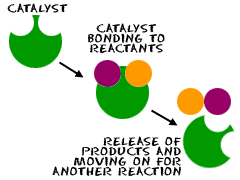 Catalysts are also used in the human body. They don't cause explosions, but they can make very difficult reactions happen. They help very large molecules to combine. There is another interesting fact about catalysts. You know that catalysts lower the activation energy required for a reaction to occur. With the activation energy lower, the products can also combine more easily. Therefore, the forward and reverse reactions are both accelerated. It changes both rates and usually changes the equilibrium point.
Inhibitors Slow It Down
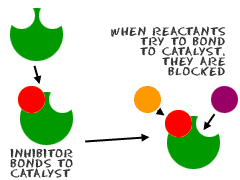 There is also something called an inhibitor that works in exactly the opposite way as catalysts. Inhibitors slow the rate of reaction. Sometimes they even stop the reaction completely. You might be asking, "Why would anyone need those?" You could use an inhibitor to make the reaction slower and more controllable. Without inhibitors, some reactions could keep going and going and going. If they did, all of the molecules would be used up. That would be bad, especially in your body. When you are watching television, you have no reason to keep breaking down sugars at the same rates you would if you were working out.
► NEXT PAGE ON CHEMICAL REACTIONS
► NEXT STOP ON SITE TOUR
► REACTIONS QUIZ
► RETURN TO TOP OF PAGE
► Or search the sites...
► NEXT STOP ON SITE TOUR
► REACTIONS QUIZ
► RETURN TO TOP OF PAGE
► Or search the sites...
Related Video...
Science Nation: Solar Fuels (US-NSF Video)
Encyclopædia Britannica: Catalysts
Encyclopædia Britannica: Catalysis
Wikipedia: Catalysts
Wikipedia: Reaction Inhibitors
Encyclopedia.com: Catalysts
- Overview
- Rates
- Measuring
- Stoichiometry
- Thermodynamics
- Equilibrium I
- Equilibrium II
- Catalysts and Inhibitors
- Acids/Bases I
- Acids/Bases II
 See the full list of chemistry topics at the site map!
©copyright 1997-2018 Andrew Rader Studios, All rights reserved.
Current Page: Chem4Kids.com | Reactions | Catalysts and Inhibitors
** Andrew Rader Studios does not monitor or review the content available at external web sites. They are paid advertisements and neither partners nor recommended web sites. Also, we do not collect or ask for personally identifiable information on any of our sites. Privacy Policy/Terms & Conditions