

Heat and Cold
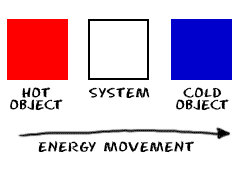 What are heat and cold? It's a pretty simple idea. When you think of heat, you probably think of fire. When you think of cold, you might think of an ice cube. It all has to do with kinetic energy in atoms. Heat has a lot of kinetic energy and gives it away. The cold doesn't have much energy and absorbs it from the surrounding area. Chemists measure heat in units called Joules. You may also hear about sinks and sources. If the temperature of an object is higher than the surrounding area, it is considered a heat source. If the temperature of an object is lower than the surrounding area, it is considered a heat sink.
Thermochemistry
There are two kinds of heat in chemistry. The first is caused by physical activity. As you get more kinetic energy, there is more activity in the system. This extra activity makes more molecular collisions occur. The collisions create the heat. This happens when you increase the pressure in a system. Chemical processes cause the second type of heat. Instead of exciting a system and feeling the heat, chemical bonds are made and broken, and the energy is then released. A release of energy charges up the system and the molecules bounce around faster, resulting in that physical activity we just explained. The opposite can also happen. Sometimes bonds are made and broken and energy is absorbed. The system then gets colder as the temperature goes down. Those emergency icepacks you see when people hurt their ankles are good examples of chemical reactions that absorb energy.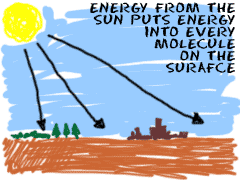 There is energy all around us. Just as matter is all around us, energy is always there. Usually, you will feel this energy as heat. Let's say it's really hot out today. Why is it hot? One big reason is that there is a lot of heat/energy coming from the Sun. The Sun is a big furnace, and that furnace heats the Earth. When a lot of the Sun's radiant energy makes it to Earth, it transmits energy to the atoms and molecules in the air and ground. Those molecules heat up. The Sun makes your molecules more excited because of the energy hitting you. You should remember that only a small percentage of the Sun's energy makes it to Earth. We're talking about millionths of a percent. The Sun gives off more energy than you can imagine, and it doesn't end there. There are also millions of stars that are bigger than our Sun. There's a lot of energy in the Universe.
Energy in Chemical Bonds
We just talked about energy in a star. There is also energy stored in the bonds between atoms. How about when you burn a piece of wood? When you burn something, you release the energy from the chemical bonds in the wood. Where did the energy come from? The Sun. A plant needs the Sun to grow. Light hits the plant and is used by a process called photosynthesis. The plant captures the Sun's energy and stores it in the chemical bonds. You have probably heard of glucose (C6H12O6), which is one of the smallest sugar building blocks made by plants. The plant uses glucose to power certain processes, to manufacture the cellulose, and as a building block in the cellulose itself. When you burn a piece of wood, you are releasing all of the energy stored up. You experience that energy as heat and light (fire).
► NEXT PAGE ON CHEMICAL REACTIONS
► THERMODYNAMICS QUIZ
► RETURN TO TOP OF PAGE
► Or search the sites...
► THERMODYNAMICS QUIZ
► RETURN TO TOP OF PAGE
► Or search the sites...
Related Video...
Science of Innovation: Synthetic Diamonds (US-NSF Video)
- Overview
- Rates
- Measuring
- Stoichiometry
- Thermodynamics
- Equilibrium I
- Equilibrium II
- Catalysts and Inhibitors
- Acids/Bases I
- Acids/Bases II
 See the full list of chemistry topics at the site map!
©copyright 1997-2018 Andrew Rader Studios, All rights reserved.
Current Page: Chem4Kids.com | Reactions | Thermodynamics
** Andrew Rader Studios does not monitor or review the content available at external web sites. They are paid advertisements and neither partners nor recommended web sites. Also, we do not collect or ask for personally identifiable information on any of our sites. Privacy Policy/Terms & Conditions